

Case File No. 023 — Culinary Cipher
7 Bacons You Should Double-Check
(And 3 Honest Ones) — when you’re paying by the pound, make sure you’re paying for the pork, not the water.
You buy bacon expecting cured pork belly, sliced and ready to sizzle. But a lot of the bacon on that shelf has been pumped up with water and a solution of additives — so you’re paying meat prices for liquid that vanishes in the pan. The label quietly tells you, if you know where to look.
Flip the pack and look for the “water added” or “solution” wording — that’s the whole story. Here are the seven things to double-check before your next pack, and three that pass.
Ignore the smokehouse story. Find the solution statement. Follow the ingredients. And Decode Your Plate.
7 things to double-check
Flip the pack before it goes in the cart.
“Water added” and “up to a solution” wording
Phrases like “water added” or “cured with up to a 10% solution” are the legal admission that the bacon was pumped with liquid — weight you’re paying for that disappears the moment it hits heat.
The pan test
Bacon that floods the pan with a milky liquid and shrinks dramatically was watered down before you bought it. Real, dry-cured bacon renders its own fat and stays closer to its raw size.
Added sugar
A touch of sugar in the cure is traditional, but some brands lean on added sugar, dextrose, or syrups more than you’d expect from a savory food — worth knowing if you’re watching sugar.
The “uncured” bacon confusion
“Uncured” sounds like it skipped curing entirely, but it’s usually cured with celery powder or juice — a natural source of the same nitrates found in a traditional cure. Still cured, just a different source.
Nitrites and processed meat, in perspective
Health authorities say processed meats are best in moderation, but an occasional weekend breakfast isn’t a crisis. Treat bacon as the enjoyable food it is, in any form.
The turkey bacon reality
Turkey bacon gets picked as the “healthier” choice, but it’s often just as processed — formed from ground turkey with binders, added water, and sodium. “Turkey” on the front doesn’t guarantee a simpler product.
Cheap bacon bits
Shelf-stable “bacon” bits, especially in the salad dressing aisle, are sometimes not bacon at all — a seasoned, textured soy product. Even real bacon bits can be heavily processed and salted.
Dry-cured vs. wet-cured
Wet-cured bacon — the common supermarket kind — is injected with a brine solution to cure it fast and add weight. Efficient and cheap, but watered down. Dry-cured bacon is rubbed with salt and seasonings and left to cure slowly, with no added water, so it fries up meatier and shrinks far less.
When a pack seems expensive, check whether it’s dry-cured — you may simply be paying for bacon that’s actually bacon all the way through.
Real smoke vs. liquid smoke
Traditional bacon is smoked over actual wood — slower, but a deep, genuine smokiness. A lot of bacon gets its smoke flavor from liquid smoke or “natural smoke flavoring” instead — faster and cheaper, and often a sign of a product cutting corners elsewhere too.
3 honest ones worth frying
Dry-cured, no added water, no disguises.
Dry-cured, no added water — a short ingredient list
Look for bacon that skips the “water added” or “solution” wording, ideally labeled dry-cured, with a simple list: pork, salt, seasonings. It costs a little more, cooks up meatier, and shrinks far less.


Honestly-labeled “uncured” — celery powder, clearly disclosed
“Uncured” still means cured, just with a natural nitrate source. Wellshire Farms discloses it plainly on the label rather than hiding behind vague marketing words.
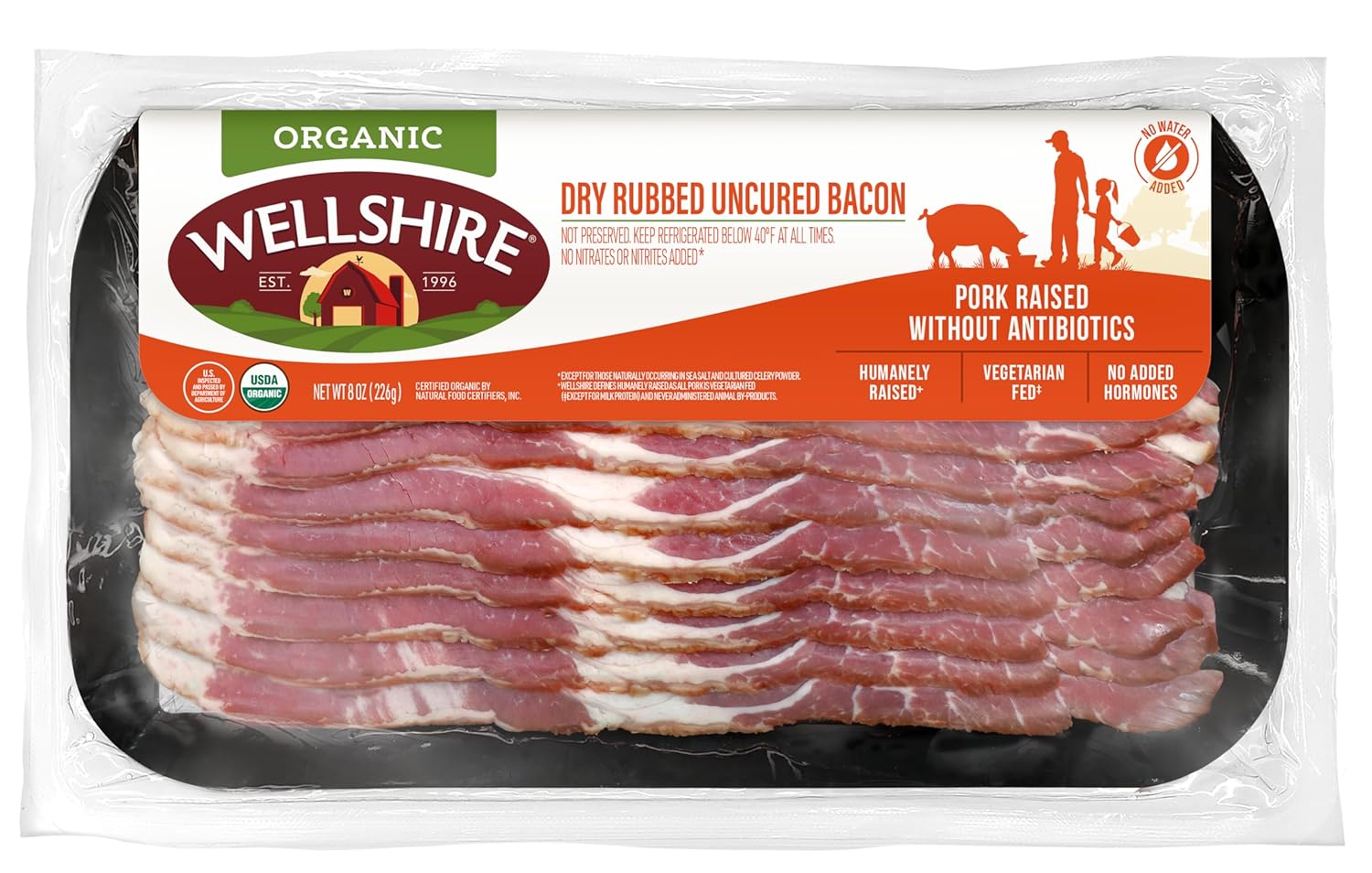
Wellshire Farms 8oz Organic Uncured Bacon
Sea salt & celery powder, no synthetic nitrates/nitrites added
Shop →Make your own
Real bacon starts with pork belly, salt, and patience — cured for about a week, then smoked low and slow. You choose the cure, the wood, and exactly what goes in. Here are two honest routes: traditional curing salt, or a celery-powder cure like the one used in commercial “uncured” bacon.
The recipe we’re using: Homemade Bacon by Kimberly Killebrew
A tested dry-cure (and wet-cure) method using Prague Powder #1, with clear guidance on safe, precise curing-salt ratios and real wood smoke.
See the full recipe →Prefer a celery-powder cure? Here’s the honest version
Some home curers swap Prague Powder #1 for celery juice powder, treating it as a “natural” alternative. It’s worth knowing exactly what that swap is: celery powder is still a source of nitrites, not an absence of them — you’re trading a synthetic source for a plant-derived one, not avoiding nitrites altogether. Used carefully, it’s a legitimate option; just don’t mistake it for “nitrate-free.”
See the celery-powder method →Note: this method is sometimes marketed as “chemical-free” — as our video covers, that’s the same labeling trick used on store-bought “uncured” bacon. Celery powder is a natural nitrite source, not a nitrite-free one.
Watch: pork belly to bacon
A quick visual walkthrough of the dry cure, smoke, and slice process, start to finish.
What you’ll need

Curing Salt No. 1 (Prague Powder), 1.5lb bottle
Shop →
Pure Celery Juice Powder, 18oz
Shop →
Digital Food Scale, 0.1g accuracy (for precise curing-salt measurements)
Shop →
Instant-Read Digital Meat Thermometer
Shop →
Ninja Woodfire Outdoor Grill & Smoker, 7-in-1
Shop →
Victorinox Fibrox Pro Slicing Knife, 12″ Granton Blade
Shop →
OSTBA Electric Meat Slicer, 7.5″ Blade, 200W
Shop →
BESWOOD 10″ Electric Deli Meat Slicer, 240W
Shop →Prefer to source local?
Find local farms and butchers for pastured pork belly near you in our Food Freedom Directory.
Browse the Directory →We’re not here to tell you bacon is good or bad. We’re here to help you understand what you’re buying, what you’re paying for, and whether the product inside matches the story on the package.
When you’re paying by the pound, make sure you’re paying for the pork. Question the claims. Read the fine print. And always — Decode Your Plate.